Outer Wilds: 10 Tips to Master the Time Loop and Explore the Cosmos
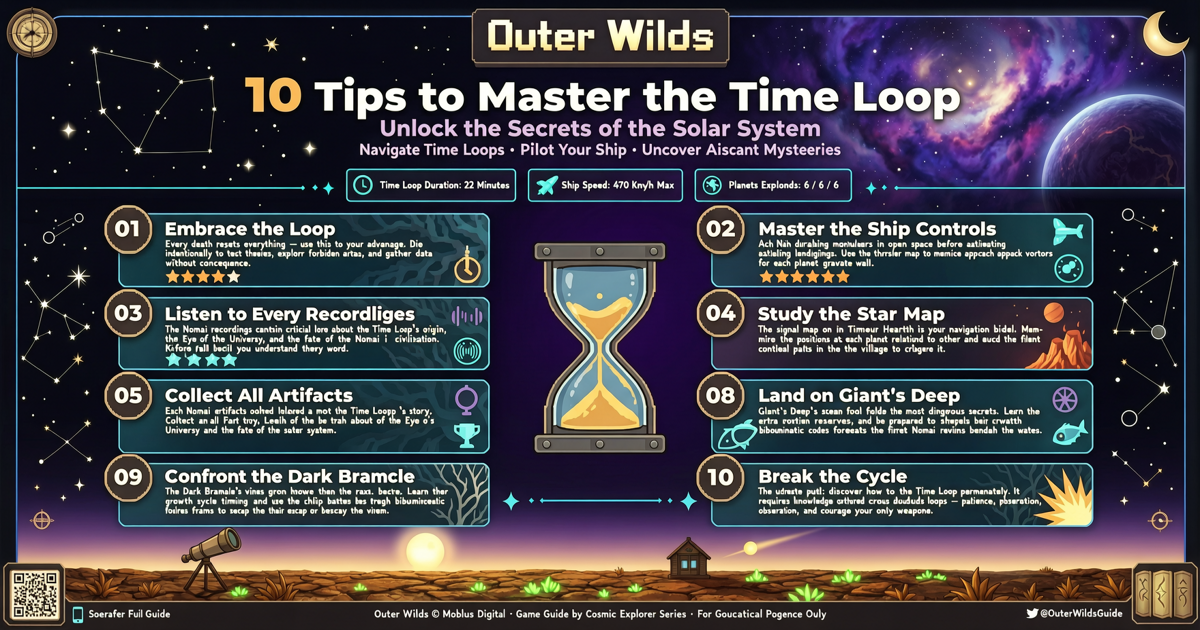
1. Embrace the Time Loop: Your Best Teacher

In Outer Wilds, you are trapped in a 22-minute time loop. Instead of fearing it, use it to experiment. Each loop is a chance to learn something new without permanent consequences. If you die or the sun goes supernova, you'll wake up back at the campfire—but your ship's log retains all discoveries. Feel free to take risks and try bold maneuvers.
2. Master Your Spaceship's Controls
Your ship has a steep learning curve. In zero-gravity, momentum is key. Use the autopilot wisely—it can fly you directly into the sun if you're not careful. Practice landing on planets like the Attlerock or Timber Hearth's moon. Remember to use your landing camera by pressing the corresponding button (L on keyboard, LB on controller) for a precise touchdown.
3. Prioritize the Museum and Your Signalscope

Before your first launch, thoroughly explore the museum on Timber Hearth. It contains crucial hints about the Nomai and their technology. Also, grab the signalscope from Hornfels. This tool is essential for locating other astronauts and mysterious signals—point it at any planet to hear faint broadcasts that guide you to important locations.
4. Always Check Your Ship's Log
The ship's log is your memory. After each loop, review the Rumour Mode via the map screen. It shows connections between discoveries, helping you decide where to go next. If a rumour says "There's more to explore here," make a note to return. The log is the key to solving the game's mysteries.
5. Tackle the Attlerock First
Begin your journey on the Attlerock, the moon of Timber Hearth. It's small, safe, and introduces you to the game's physics. Explore the crater with Esker and then find the Nomai ruins underneath. This site teaches you about the Nomai text translation and provides your first clue about the Eye of the Universe.
6. Use Your Jetpack Sparingly—and Master the Boost
Your jetpack fuel is limited. Use short bursts to conserve it. On low-gravity worlds like the Moon or Brittle Hollow, you can jump vast distances with minimal fuel. The upward boost (Space + Shift on PC, or holding jump on controller) is powerful—use it to ascend quickly, but be mindful of your fuel gauge.
7. Beware of the Sun's Gravity
The sun's gravity is immense. If you get too close, you'll be pulled in. Always keep an eye on your proximity. The autopilot can accidentally lock you on a collision course with the sun. Disengage autopilot immediately if you see your trajectory heading sunward. Use the map to plot safe routes.
8. Explore Every Planet—But in Order of Difficulty
Planets vary in danger. Start with the Attlerock and Timber Hearth's moon, then move to the Hourglass Twins (Ember Twin and Ash Twin). Next, tackle Brittle Hollow (watch out for falling rocks) and Giant's Deep (avoid the cyclones). Finally, venture to Dark Bramble—the most dangerous area, home to anglerfish. Always equip your signalscope to listen for clues.
9. The Nomai Texts Are Clues, Not Obstacles
You cannot read Nomai text at first. You'll need to find the Translator Tool on the Attlerock. Once you have it, scan any Nomai wall or writing to get translations. Pay close attention to the content—it often reveals story progression and hints for puzzles. If you're stuck, reread your log entries.
10. Don't Forget to Enjoy the Journey
Outer Wilds is about discovery, not completion. The ending is bittersweet, but the real reward is the experience of exploring a tiny, handcrafted solar system. Talk to other Hearthians, listen to their gossip, and soak in the atmosphere. Every loop is a chance to find something new—embrace the wonder.
Final Tip: If you get frustrated, step back. The game rewards patience and curiosity. Use the 22-minute loops to your advantage; you'll soon uncover the secrets of the Nomai and the mysterious Eye of the Universe.